It can be frightening when someone you know is in critical care, particularly when it’s unexpected. Many families do not know the meaning of critical care or the reasons why a doctor might recommend it. Knowing what signs to look for and what you can expect is a helpful tool to help ease the stress of this level of care. You’ll find a straightforward explanation of when critical care is needed, and what families can do to help their loved ones during this time.
The meaning of Critical Care?
Critical care is a specialised form of medical care provided to patients with a serious illness or injury that poses a risk to the function and/or survival of one or more vital organs. The critical care unit has special monitoring equipment, high-tech life support equipment and a team that is ready to act quickly if there is a sudden shift in the patient’s condition, compared with a hospital ward. This type of care is only available when the attention of the physician is needed on a minute-by-minute basis for recovery or to avoid major problems.
Here are some warning signs that might indicate the need for critical care:
Some signs indicate that the patient is suffering from more serious conditions and thus requires critical care. These include:
- Breathing which is difficult, fast, or shallow.
- Sudden confusion, unresponsiveness or loss of consciousness
- Chest pain accompanied by sweating, nausea or shortness of breath
- A rapid decline in blood pressure.
- Severe bleeding that doesn’t stop
- High fever and great weakness
- Sudden confusion and trouble understanding others’ speech
- Low pulse or irregular pulse.
A combination of these signs, or any single sign, is a sign that something is amiss and in need of emergency medical treatment immediately.
Common conditions that often need critical care
There are many medical conditions which often result in a critical care admission. When someone has a heart attack or has very severe heart failure, constant surveillance is needed to safely control the function of the heart. The first few hours are critical to stroke care and require specialised treatment to minimise long-term effects. Severe infections, which can spread to the blood, can cause multiple organ involvement, referred to as sepsis, that needs close monitoring. Other frequent causes for transfer to critical care include: major trauma from accidents, severe breathing problems from illness such as pneumonia or lung failure and complications following major surgery. When there is organ failure, such as in the kidneys, liver or lungs, this is one time when such a level of monitoring is needed.
The significance of timing
For critical illness, the delay from the onset of symptoms to treatment can have a significant effect on the outcome. Some critical care illnesses, like strokes and heart attacks, are much more easily controlled if treated within the first few hours. Nothing is more detrimental to a case than waiting for a few days or hours to seek medical care when needed. That’s why doctors always recommend that families not wait or self-diagnose when serious symptoms are present and seek immediate evaluation.
When critical care is required, how do doctors decide about it?
Before deciding on the level of care to be provided to a patient at the hospital, the doctors consider a few aspects. This includes key vital signs, such as blood pressure, oxygen levels, heart rate, breathing pattern, and the patient’s overall alertness and responsiveness. Any lab tests or scans may also be ordered to assess organ function and determine the cause of the symptoms. From these results, the medical staff decides if the patient requires the constant medical surveillance and sophisticated care a critical care unit can offer, or can he or she be treated safely in a regular ward.
What is it like to be in a Critical Care Unit?
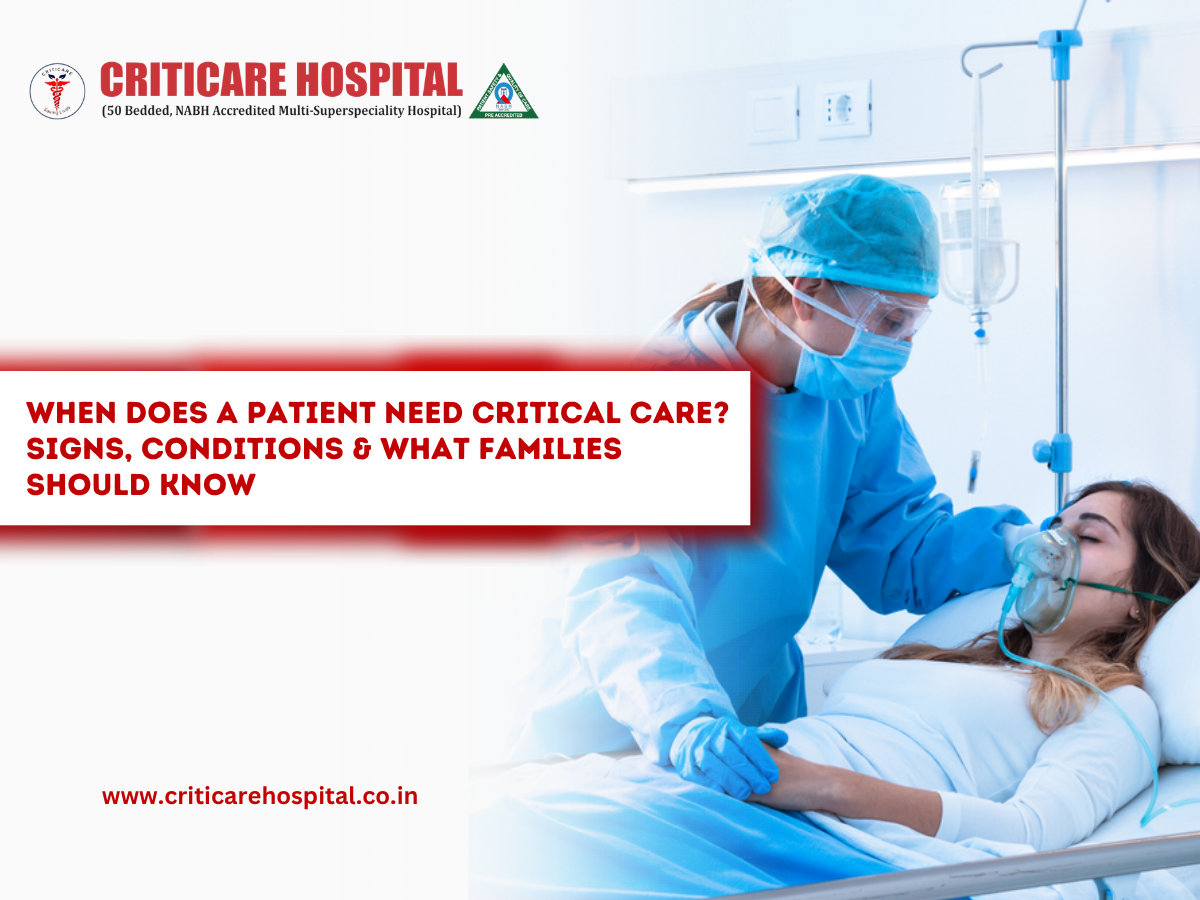
Upon admission, the patient is kept under constant observation, with machines monitoring his or her heart rate, oxygen, blood pressure and other vital functions around the clock. These could include ventilators to help the patient breathe, blood pressure stabilising drugs and other advanced treatments as appropriate. A team of doctors and nurses who are dedicated to the patient’s care are always nearby and can modify the treatment as the patient improves or deteriorates. This continuous practice, which allows critical care teams to quickly adapt to even minor changes in a patient’s condition, is what makes it different.
List of some of the things families should know
It’s difficult to be emotionally prepared when someone you love is in critical care, but it’s helpful to know what to expect. Visiting hours may be restricted to ensure a patient’s recovery and to minimise the risk of infection; this can be challenging, but it is for the patient’s benefit. You should ask questions and find out what’s happening and the treatment plan that is being followed, as doctors will give regular updates on the patient’s condition and treatment. Patients’ conditions can also vary during this time, and families should trust the medical team to be honest and clear with them, instead of taking everything they say on board at face value.
Here are some ideas on how families can offer support
The management of the medical aspect is handled by specialists, but families are still important. Maintaining a calm and present demeanour, especially if it is a trying time, can be comforting for the patient. Having medical information and being able to ask “what happened” questions assists families in staying informed and involved in decisions. It is also important to care for yourself during this period, as supporting a family member who is critically ill can become physically and emotionally demanding over a prolonged period.
Conclusion
Knowing the signs to look for to indicate a critical care requirement and what is likely to happen when a patient arrives at critical care can make a challenging situation less daunting. In such cases, timely medical care and quick action can mean the difference between life and death. Our critical care team at Criticare Hospital in Lucknow is trained and prepared to attend to you when you need it the most, with state-of-the-art monitoring facilities.