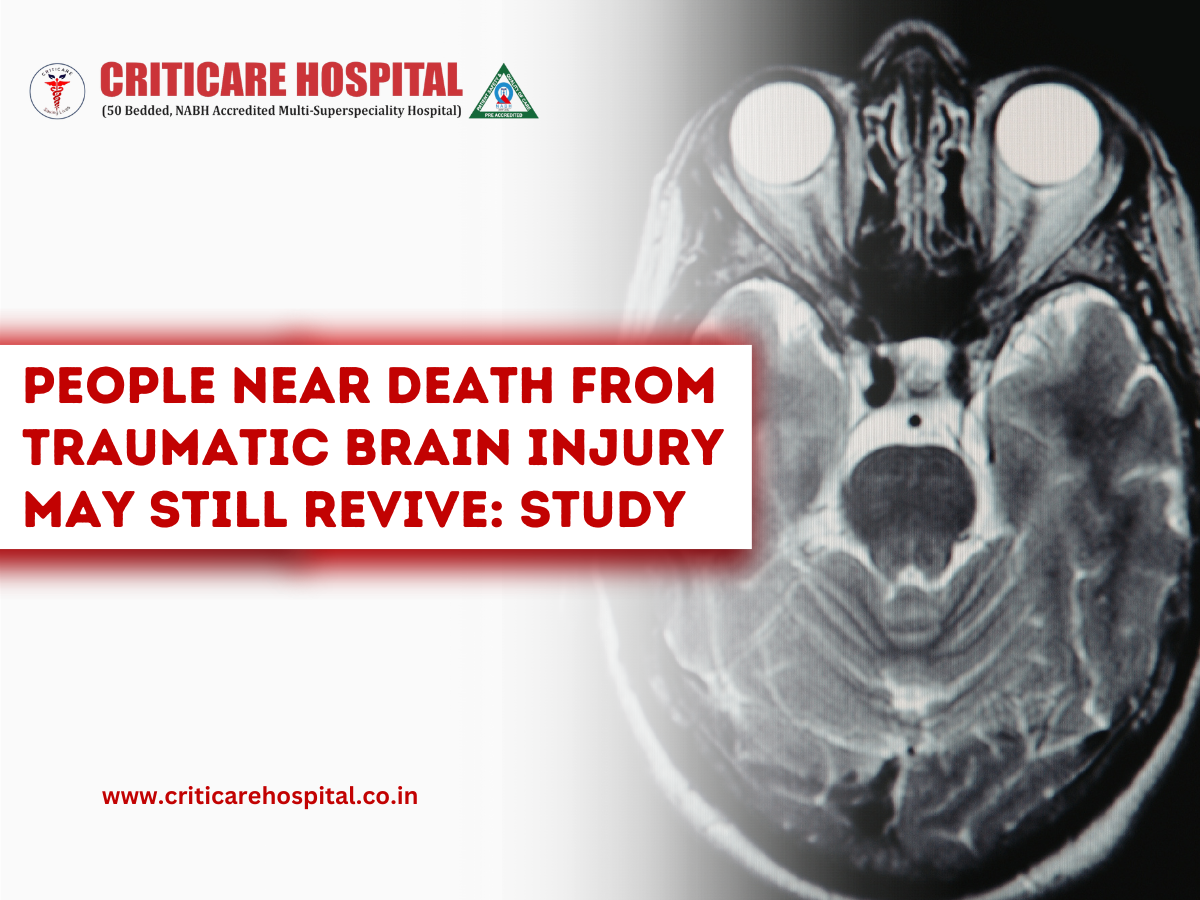
To families who are waiting in the intensive care unit, there is no worse phrase than Traumatic Brain Injury (TBI). Previously, in the case of a patient who sustained a huge brain damage and was not showing any signs of recovering, most people would have suspected that he/she was almost dead. But there is new medical research that is altering our thinking about the possibility of the brain to heal.
We observe a large number of patients in Criticare Hospital located in Lucknow, who underwent life-threatening accidents. We understand that the road to recovery is usually a long and unpredictable one. According to the more recent studies, it does not necessarily mean that an individual who seems to be close to death or in an unconscious state will not be able to recover and become conscious. The findings as expounded in this blog are in easy comprehensible terms and what they imply to families that are clinging on to hope.
Learning to see the “Quiet” brain
In case of severe traumatic brain injury in a person, the brain tends to go into a deep state of hibernation. The patient might seem fully unconscious to a doctor or a relative, he or she does not open their eyes, does not speak, does not even move according to the instructions. It is commonly referred to in the medical world as a coma or a vegetative state.
Recent research has discovered that the body may have given up, but the brain may still be operating in the background. Through sophisticated technology, researchers have found out that there are patients with concealed consciousness. This implies that they are unable to control their muscles so that they can demonstrate that they are awake but their brain cells are active and reacting to the world around them. This is an enormous move towards the treatment of emergency cases within Criticare Hospital.
The reason why there are patients who can revive
The brain is simply miraculously tough. The brain is different to other body organs in that it attempts to rewire itself in case of an injury. During the initial stages following a traumatic experience, the brain tends to swell hence severing communication between the various sections of the mind. With this swelling decreasing, as it does, with modern medical attention, the broken connections may occasionally begin to bond again.
According to the most recent studies, the number of patients who had supposedly no possibility of being cured at least indicated improvement several months, or even a year down the line. Time and special attention are the key. It happens that the process of rebooting the brain can become much longer than we have assumed. It implies that the state of a patient during his initial days is not always the determinant of his or her future.
The advance surveillance in Lucknow
We apply efficient monitoring equipment at Criticare Hospital to closely monitor the activity of the brain. Previously, physicians used to call upon physical examination exclusively, such as testing whether or not the pupils of the patient were responsive to light. Even though these are still significant, we now realize that they do not give us the entire picture.
Nowadays, physicians have the opportunity to examine blood circulation and brain electric activities with specialized tests. Such examinations aid in diagnosis of the patients who may be locked-in. Once we detect evidence that the brain is not dead, then we can make amendments to our treatment schedules to provide such a patient with the best possible opportunity to wake up. The presence of this technology in the city and specifically in Lucknow would imply that a family does not have to drive long distances in search of high quality neuro-critical care in the world.
The significance of waiting patiently
The waiting game is one of the most difficult in the process of dealing with a traumatic brain injury. Due to the slow healing process of the brain it may take weeks or months before any definite signs of recovery are realized. The recent research stresses that we are not to be too fast to judge the ultimate result of a brain injury.
Very little things can be used to initiate revival: a minor twitch of the eyelid, a squeeze of the finger or a shift in breathing when the loved one speaks. These are the smallest of movements that the brain is moving in the right direction. In Criticare Hospital, our medical and nursing staff are conditioned to seek these micro-signs of recovery to make sure that each small accomplishment is captured and added on.
The role of Families in the Recovery
When you come to the side of a loved one who had suffered a stroke to the brain, you are more influential than you may think. Because it has been researched that some patients are still capable of processing information even when they are unable to move, we are urging families at Criticare Hospital to communicate with their loved ones.
Read to them about home, or read them their favourite music, or take their hand. These are the sounds and touch that are familiar, they serve as a bridge and they keep the brain in touch with the world. Families should also take care of their health at this period. The process of recovering is a marathon and not a sprint and to have a loved one, you have to remain strong enough to support yourself throughout the long process.
Why Criticare Hospital to treat TBI?
Ashiyana is an emergency and critical care hospital based at Criticare Hospital, Ashiyana. We realize that time is of the essence, as far as the brain is concerned. Our hospital will be developed as one that offers 24/7 service to traumatic injuries, with the best medical equipment and a caring heart.
We do not merely look at some cases but at a man and a family and a future. Our neurologists, surgeons, and therapists collaborate to establish the road to recovery founded on the current medical evidence. Our mission is to provide each patient with time, attention and sophisticated care that they require to overcome the odds and find their way back to health.
Conclusion:
The fact that individuals who are almost dying of brain injuries can still revive is an eye opener that medical science has continued to make progress. It informs us that the brain is a powerful and enigmatic organ that cannot be discussed in a linear fashion. Although the journey towards recovery following a traumatic brain injury can never be smooth, it is a journey that is gradually becoming full of promise.